
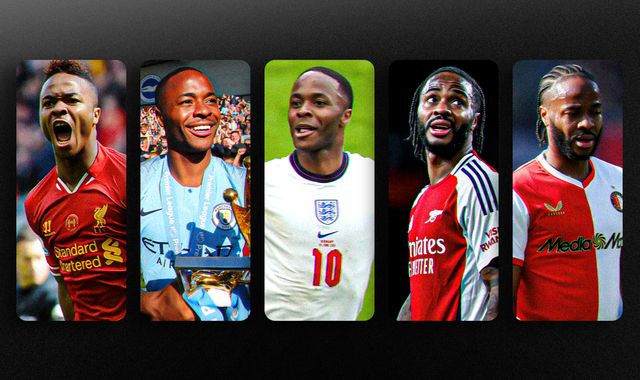
There once existed a time where Raheem Sterling was an unstoppable force. A player with a uniquely abstract running style, he still somehow evoked effortless poise when moving with the ball. A glider across a pitch.
Sterling played a dominant role in Manchester City's most definitive era, one led by the greatest tactical mind of a generation. But this forward exuded genius of his own.
A teenage prodigy that climbed his way to the very top of the game, Sterling was driven by his origin story rather than burdened by it. At his height, he drew comparisons to Lionel Messi and Cristiano Ronaldo as a player capable of "winning the race", according to Barcelona great Xavi, to become the world's next best thing.
- Raheem Sterling handed suspended prison sentence
- England latest news
His 82 international caps pointed towards a boundless trajectory; England's most impactful player on their run to the Euro 2020 final. In an alternate world, he would still be part of Thomas Tuchel's England set-up now, the coach being a key advocate for the move that took Sterling from Man City to Chelsea in 2022. He was still only 27.
For a player that burst onto the scene an entire decade before, Sterling's status and authority at the top was enduring. He made his Liverpool debut at 17 and his senior England bow 24 days before his 18th birthday. The peak of his Premier League powers ran parallel with many of the game's elite performers. That should not be forgotten.
And yet, the cut and thrust of the limelight, however perpetual, had consequences. Its punishing effects are all that seem to remain of a career fatigued by comebacks. Perhaps this particular juncture, one that has seen Sterling receive a suspended sentence for dangerous driving and possession of nitrous oxide, is one return too many.
Throughout the now-31-year-old's on-field journey there were many flashpoints of tension. From his acrimonious Liverpool exit to his eventual exile at Chelsea, Sterling was poured over: talked about, written about, dissected and scrutinised from one performance to the next. That is the reality of a modern-day footballer.
He divided public sentiment throughout that time but almost always used the immensity of his talent to wage war on the pitch, continuing to produce when it really mattered.
Sterling rejected his characterisation of a "money-grabbing 20-year-old" before leaving Liverpool in 2015. His time at Man City yielded four league titles, including a domestic treble where he was championed as "Wembley boy" after scoring twice in the FA Cup final. A full circle moment for the kid who had grown up in nearby Neasden watching the new stadium being built.
"One reason why we are here is Raheem," raved Pep Guardiola. Sky Sports' City reporter Ben Ransom remembers his contribution equally fondly: "His dribbling electrified the Etihad and 'typical City' at that time was a flowing move finished by Sterling. The title-winning sides of 2018 and 2019 were the best teams I've ever seen in the Premier League."
Earlier in his international career, Sterling's setbacks also played out in the public domain. There was a run-in with Roy Hodgson over being "too tired" to play, before being a principal scapegoat for England's Euro 2016 exit. Despite becoming increasingly prolific for Man City, Sterling went 27 international appearances without scoring. After a tirade of online abuse, some of it racially motivated, he labelled himself #TheHatedOne.
But the script flipped spectacularly in October 2018 in a 3-2 win over Spain and he grew to become decisive at the next major tournament in 2021; England's most reliable creative source. Once again doubters were silenced. Critics caged until the next episode, which of course was destined to surface before long. This is Raheem Sterling.
Towards the end of his time at City he had lost his starting place but the passion to compete still burned. To start again seemed sensible. But leaving the structure of a club steeped in recent success for a Chelsea side thrown into chaos by the Clearlake-Todd Boehly takeover was unlikely to offer much solace. Besides, Sterling's output was already stalling.
A line from his first Chelsea address to reporters sticks in the mind.
"I felt my game time at Man City was getting limited for different reasons and I couldn't afford to waste more time," he said in August 2022. "When I look back in the future, I never wanted to see a rise then a decline." The sense of foreboding is hard to overlook.
Another challenge of the modern-day superstar, one that soars to fame in their teenage years, is physical toll. The deterioration of a player so reliant on speed and burst for goals was perhaps always going to happen. The only question was when. "City were built with a blend of technical brilliance, fluidity and speed. On the pitch Sterling excelled in all of those areas," Ransom remembers. But pace can be both a blessing and, latterly, a curse.
Sterling had reached 500 career appearances by the age of 26. He has played 157 times since then; wear and tear an inevitable byproduct of so many minutes. Even Mikel Arteta, who worked closely with Sterling at City, could not reawaken his spark.
His loan period at Arsenal was meant to liberate a player scorned by Chelsea's churn but ended with one solitary strike in a Carabao Cup meeting with Bolton; which looks to be his final career goal. The less said about his ill-fated stretch at Feyenoord the better.
Of course Sterling was not just a victim of his tiring legs. Reports suggest his conduct at Chelsea was not always exemplary - clearly a frustrated figure forced to train alone but one that no longer set the standards of a professional at the very top of his game.
It will be characterised as the beginning of the end for a player that posted double figures in every single campaign while at City. One might also question whether Chelsea's treatment of him was just, too.
Sterling's career reaching its nadir at Basingstoke Magistrates' Court feels sad. Many will tell the tale of the rise and fall of one of the Premier League's best. Really, the narrative should reflect an individual whose impact was immense in the face of adversity and who used his platform for good during the peak years.
Ransom tells the story of a figure that "arguably made an even bigger impact off the pitch, publicly pointing out blatant hypocrisy and challenging stereotypes of Black athletes. Sterling didn't just speak up, he took on one of the most powerful newspaper editors in the country. He was a difference maker in every way." The Queen awarded him an MBE in 2021.
Whether Sterling was misaligned or misguided - or both - is up for interpretation. Whatever the judgement, he should not be pardoned for his recent trespasses. But nor should his many achievements be reduced to nothing.
(c) Sky Sports 2026: Raheem Sterling enjoyed a wonderful Premier League career but regularly attracted controversy - is there any way back?
 Raheem Sterling: Former England international given suspended 12-month jail sentence for dangerous driving
 Sandpapergate: Usman Khawaja 'hurt' by 'personal attacks' from Pat Cummins as he details Cameron Bancroft relationship
 Senegal crowned AFCON 2025 champions by Court of Arbitration for Sport following appeal
 Chantelle Cameron: Unified super-welterweight world champion agrees contract extension with Jake Paul's MVP