

English football's biggest clubs are preparing to vote next week on a landmark 10-year deal to provide in the region of £1.5bn in extra funding to their lower league counterparts as they target a binding agreement within weeks.
Sky News has obtained exclusive details of the latest version of the 'New Deal', which has been the subject of on-off discussions among English football's power-brokers for over three years.
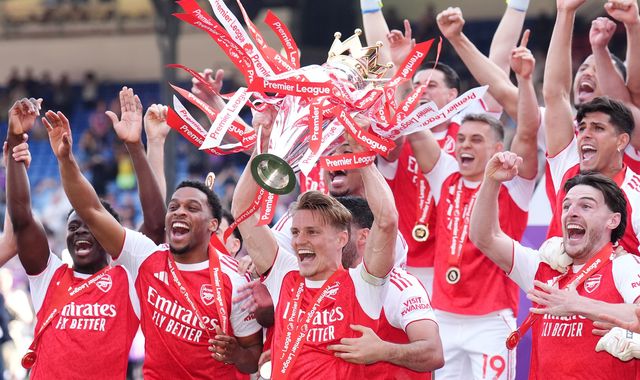
It can be revealed this weekend that clubs including newly crowned Premier League champions Arsenal, Aston Villa, Manchester United and Sunderland are aiming to meet next Thursday to vote on a deal aimed at creating a long-term framework to underpin the financial sustainability of the professional game in England.
Among the key details of the proposed pact - the outline of which has been shared with the English Football League's board and the Independent Football Regulator - is a proposal to lift the Premier League's transfer levy from 4% to 6%, with the increase funding part of the New Deal payments.
As an example, Chelsea's £117m transfer fee this week for the Aston Villa and England midfielder Morgan Rogers would incur a £7.02m payment under the new framework, up from £4.68m.
Under the proposals, the bulk of the New Deal money would be paid by clubs based according to the roughly 1.7:1-1.8:1 revenue ratio that the Premier Leagues uses to distribute parts of its broadcast income.
If adopted, this template would make clubs such as Arsenal, Chelsea and Manchester City among the biggest contributors to the New Deal.
The vote - if it takes place next week - will require a majority of 14 clubs to vote in favour for the resolution to pass.
The deal would then be proposed formally to the EFL.
However, further discussions are scheduled to take place in the next few days, and it is not yet certain that a formal vote on Thursday will be possible.
Although the precise overall value of the proposed decade-long deal was unclear on Saturday, sources said it involved a sliding scale of payments beginning as soon as the forthcoming 2026-27 season if an agreement can be struck in time.
The first annual payment is likely to be less than £100m, rising to more than £130m in the second year and then to about £160m in year three, with the value then pegged at that level during the remaining seven years of the deal.
That would amount to an overall sum over ten years of in the region of £1bn, although these figures could not be corroborated and may differ materially in any deal which remains the subject of intense negotiations, insiders warned.
This weekend, one source close to the EFL described some of the proposed terms as "insufficient" but declined to expand on its objections.
Other key aspects of the New Deal are understood to include a gradual reduction in parachute payments which are made by the Premier League to relegated clubs over a three-year period, and a new lifeboat fund worth £20m which would be used to assist any EFL club which falls into administration.
The agreement would also require a guarantee that 20% of funds received by EFL clubs under the deal must be spent on infrastructure investment, in an effort to reduce the chances of funds flowing straight through clubs' coffers and into players' transfer fees and wages.
Sky News revealed last month that Premier League clubs had given chief executive Richard Masters a mandate to negotiate a deal with the EFL over the summer period.
One football industry source not involved in the talks said the deal appeared to be "constructed as much with the regulator in mind as the EFL".
The IFR, led by chairman David Kogan and chief executive Richard Monks, has repeatedly indicated that it wants a deal to be agreed as quickly as possible.
Under powers granted to it in the legislation which paved the way for its creation, the watchdog possesses a backstop power enabling it to impose a financial redistribution settlement on the Premier League and the EFL.
Mr Kogan has said that the IFR being forced to step in to impose a deal would reflect "an utter failure" by English football's power-brokers.
"Going forward, it's to everyone's benefit for football to try to reach this understanding," he told an industry conference this year.
"But if the leagues can't find a new deal, those powers will be enacted, and we will be looking at things such as the current mechanism for parachute payments."
Sources said the Premier League's objective was to reach a deal by the end of August, ahead of the publication of the first version of the IFR's State of the Game report, which will be released in the autumn.
The review will examine how financial flows within the game have shifted, including in relation to "cliff-edges" between or within leagues.
If a bilateral agreement can be struck, it would rank among the most significant moments in English football since the formation of the Premier League in the early 1990s.
Talks about the latest iteration of the deal come as the Premier League introduces a new financial model for clubs called the Squad Cost Ratio, which will cap their on-pitch spending at 85% of their football-related revenue and their net profit or loss from player sales.
The New Deal could also include a requirement for clubs in the Championship to transition to the same structure.
This weekend, the Premier League, EFL and IFR all declined to comment.

(c) Sky News 2026: Premier League clubs prepare to vote on landmark £1.5bn deal with EFL
 India's 'Cockroach' movement to end protests after education minister quits
 Several injured in Berlin after car drives into crowd, police say
 Residents 'upset and angry' over Cairngorms wildfire evacuation orders
 UK set for fourth heatwave next week
 Madeleine McCann's brother represents Scotland in Commonwealth Games swim final