

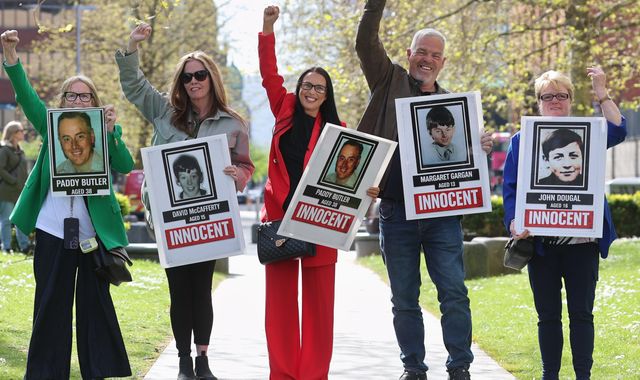
Two soldiers "overreacted and lost control" when they shot dead three teenagers and two adults in Belfast in 1972, an inquest has found.
Mr Justice Scoffield said the force used was "not reasonable".
He rejected claims the soldiers were reacting to a mass "coordinated" attack on a timberyard where they were based and said radio logs "hugely undermine" that narrative.
A priest, a father-of-six, and three teenagers were killed in the incident in the Springhill and Westrock areas on 9 July 1972.
They were: John Dougal, 16, David McCafferty, 15, Margaret Gargan, 13, Father Noel Fitzpatrick, 42, and Patrick Butler, 38.
The coroner said four of them hadn't been involved in any attacks on the Army and were unarmed when they were shot.
He was unable to conclude the same for John Dougal, who was in a junior wing of the IRA, but said even if he had a gun he wasn't using it and was probably running away when he was shot in the back.
Father Fitzpatrick and Mr Butler were killed by the same bullet as they attempted to cross the road from an alleyway, the inquest concluded.
Teenager David McCafferty, who was also in the IRA's youth branch, was shot in the back as he tried to retrieve the priest's body.
The soldier who killed all three, referred to as 'Soldier A', was less than 100m away at Corry's Timber Yard and "fired prematurely" without warning and without assessing if they posed any risk, the coroner said.
Margaret Gargan, 13, who was speaking to two friends on the pavement, was shot in the head by 'Soldier E' from the same woodyard.
Once again, the coroner said there was no warning and there had been no firing from her location at the time.
Mr Justice Scoffield said both soldiers had "overreacted and lost control".
Mr Justice Scoffield said the claim that "not one shot had been fired" by civilians before the soldiers opened fire was "much too simplistic".
He acknowledged the soldiers may have been influenced by sporadic civilian firing, but rejected their claim they were reacting to "a coordinated attack by a mass of gunmen".
They were young and inexperienced, the coroner added, and had "ignorance" about the political context.
He said the soldiers at the timberyard would also have been "nervous and fearful" as an IRA ceasefire broke down.
Deadliest year of Troubles
The incident happened in the deadliest year in Northern Ireland's history, with almost 500 killed, including 13 infamously shot dead by the British Army on Bloody Sunday.
On 9 July, tensions rose after a ceasefire gave way during unrest in the Lenadoon area of west Belfast.
Families and supporters of those killed - including former Sinn Fein president Gerry Adams and West Belfast MP Conor Maskey - earlier walked to Belfast Coroner's Court with a banner reading "time for truth".
Read more from Sky News:
Teens jailed for killing man they believed was a paedophile
Neo-Nazi found guilty of planning mass gun attack
The inquest, which heard more than 70 days of evidence, ended in April 2024, just hours before the former government's deadline on Troubles-related cases.
It was the last of a series of investigations completed before the Legacy Act came in - a law Labour is now in the process of replacing..
Today's finding comes after a fresh inquest was ordered in 2014. The original one in 1973 returned an open verdict.

(c) Sky News 2026: British Army soldiers who shot five dead in Belfast in 1972 'overreacted and lost control', c
 Former Spandau Ballet singer Ross Davidson jailed for 14 years for rape and sexual assault
 Three teenagers who killed man they believed was a paedophile have been detained for 19 years
 How the UK's terror threat levels work
 Neo-Nazi found guilty of planning mass gun attack after being caught in MI5 sting
 London station evacuated after 'number of passengers complained of feeling ill'