
An injection that eradicated entire tumours in patients with otherwise treatment-resistant cancers in a trial has been praised for its "striking" benefits.
The jab, which could potentially benefit thousands each year, shrank the tumours in 42% of patients with recurrent and or metastatic head or neck cancer.
The small amivantamab injection, which was described as having only mild to moderate side effects, was given to people who had stopped responding to standard treatments.
Tumours shrank in 43 participants of the Institute of Cancer Research (ICR) international study - 15 had their tumours disappear completely, and 28 saw their tumours shrink significantly.
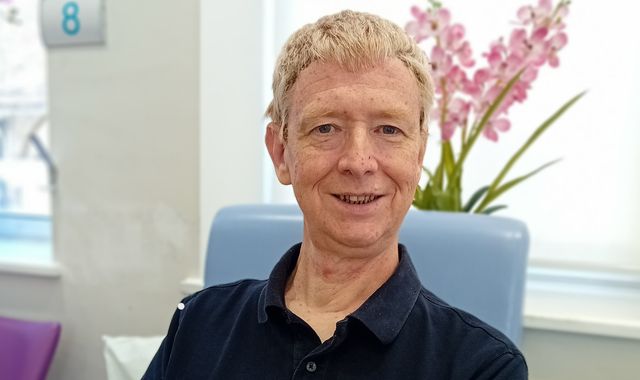
One participant with tongue cancer said the treatment reduced his pain and swelling, and that he no longer experiences the "life-impacting" side effects he had during chemotherapy.
Professor Kevin Harrington, professor in biological cancer therapies at the institute and consultant oncologist at The Royal Marsden NHS Foundation Trust, said: "These are unprecedentedly strong responses in patients whose disease has become resistant to both chemotherapy and immunotherapy.
"This is a group of patients for whom treatment options are extremely limited, so seeing this level of benefit is very striking."
Head and neck cancer is the sixth most common cancer worldwide, and it affects around 12,800 people in the UK each year.
This phase of the OrigAMI-4 trial looked at 102 people with recurrent or metastatic head and neck squamous cell carcinoma (HNSCC), whose cancer had continued to grow despite immunotherapy and platinum-based chemotherapy.
Patients with amivantamab lived for a median of a year and five months after starting the treatment, despite having a cancer type with "very poor outcomes" once standard treatments stop working, the ICR said.
Tumours started to respond within about six weeks, and patients had a median of a little more than six-and-a-half months before the cancer started to grow again, it found.
Carl Walsh, 56, from Birmingham, was diagnosed with tongue cancer in May 2024 and joined the study at The Royal Marsden in July 2025 after chemotherapy and immunotherapy were both unsuccessful.
In a statement released by the ICR during his 17th treatment cycle, he said: "I now feel able to live a normal life. Before starting the trial, I struggled to speak properly and found eating difficult because of the swelling and pain."
Read more from Sky News:
Former M&S boss drafted in to help ministers tackle NEET crisis
WHO chief heads to Ebola epicentre
The patients, from 55 hospitals in 11 countries, only received amivantamab, which is being developed by Johnson & Johnson.
The drug, a bispecific monoclonal antibody, blocks two signals: EGFR (Epidermal Growth Factor Receptor), which is a protein that helps tumours grow; and MET, a separate pathway often used by cancer cells to escape treatment.
The jabs were given every three weeks and contrast with many cancer treatments, which require intravenous drips.
One participant with tongue cancer said the treatment reduced his pain and swelling, and he is no longer experiencing the "life-impacting" side effects he had during chemotherapy.
The study excluded patients who had human papillomavirus (HPV) positive oropharyngeal squamous cell carcinoma.
Head and neck cancers that are not caused by HPV are usually harder to treat and have poorer responses to standard therapy, ICR said.
The study is being presented to the American Society of Clinical Oncology on Sunday.

(c) Sky News 2026: 'Striking' cancer jabs destroys tumours in treatment-resistant cases in trial
 Police officer opens fire and is struck by stolen PSNI car
 Two more children's sand kits withdrawn from sale over asbestos content
 Hundreds arrested across France during unrest after PSG win - as more than 50 officers injured
 Five recover from Ebola - as Brazil investigates two suspected cases
 'More than 45' killed after blast at building storing explosives in Myanmar