
By Rebecca Black and Jonathan McCambridge (Press Association)
Two soldiers “lost control” in the fatal shootings of five people in Belfast almost 54 years ago, a coroner has said.
The British Army soldiers did not use reasonable force in the shooting of a Catholic priest, a father-of-six and three teenagers in two areas of west Belfast on July 9 1972, the coroner ruled.
Mr Justice Scoffield said that Father Noel Fitzpatrick, 42, father-of-six Patrick Butler, 38, and teenagers David McCafferty and Margaret Gargan were unarmed and posed no risk when they were shot.
Families, friends and supporters of the five gathered at Belfast Coroner’s Court and applauded and hugged each other as the findings were read out.
The group included former Sinn Fein president Gerry Adams, junior minister Aisling Reilly, West Belfast MP Conor Maskey and People Before Profit MLA Gerry Carroll.
In his findings, Mr Justice Scoffield said Father Fitzpatrick and Mr Butler were killed by the same bullet as the priest looked left and Mr Butler looked right as they attempted to cross the road from an alleyway.
Mr Butler was likely assisting the priest with those who had been injured and was the “most maligned” victim by false claims that he was an IRA gunman or a known terrorist, the coroner said.
David McCafferty, 15, was seeking to retrieve the body of the priest when he was shot in the back.
The coroner said that while he was involved in the youth wing of the IRA, he was not engaged in any “activity” on that day and “should be viewed as an innocent” person.
A soldier who fired the shots that killed all three, known only as Soldier A, was less than 100 metres away at Corry’s Timber Yard.
The coroner concluded that the soldier “fired prematurely”, “lost control” and shot without having first made an assessment of the risk, if any, they posed.
He said he was satisfied that no warning was given, and that the three victims were not carrying any weapons.
He said even if the soldier believed he needed to use force to defend himself, the force used was not reasonable.
A soldier known only as Soldier E, who was located at the same woodyard as Soldier A, shot 13-year-old Margaret Gargan in the face while she stood on a pavement and spoke to friends, the coroner said.
The coroner referred to a statement given by Soldier E who described shooting a man around 20 years old described as 5ft 8inches in height, and deemed this to be referring to shooting Ms Gargan as it was “very difficult” to know who else it could refer to.
He said it was possible the soldier mistook the risk the schoolgirl posed, and said Ms Gargan was frequently described as a “tomboy” and could be mistaken as a male youth.
He said her friends were not visible and she was on her hunkers beside the hedge in what could be taken as being in a position of concealment.
But he said was not convinced this explained the shooting of Ms Gargan, and said it was also possible the narrative was created after the event, when the soldier knew the individual posed no risk, and before giving an official statement.
He said the “later contention that she was an armed gunman was self serving”, and that the soldier had “sufficient time” to assess the actions and demeanour to assess the risk posed.
He said it was “more likely” the soldier fired “prematurely”, without making a proper assessment of the risk.
In the case of the other teenager, 16-year-old John Dougal, the coroner said he was unable to conclude whether he was armed when he was shot.
He said the teenager was a member of the junior wing of the Provisional IRA but said on balance he concluded he had not progressed into the ranks of the adult IRA.
The coroner said even if Mr Dougal had been in possession of a firearm, he was not using it and was likely running away when he was shot in the back.
He said: “With John Dougal shot in the back as he ran from the area and taking into account the requirements of the yellow card, the force used by Soldier A was not reasonable.”
He said that Soldier A, who shot Mr Dougal, Fr Fitzpatrick, Mr Butler and David McCafferty, and Soldier E, who shot Ms Gargan, had “overreacted and lost control”.
Mr Justice Scoffield rejected the explanation that the soldiers were reacting to a mass “coordinated” attack on Corry’s Timber Yard, where the soldiers were based, and said the brigade radio logs “hugely undermine” that narrative.
He said he also rejected the civilian case that “not one shot had been fired” by civilians before British Army soldiers began firing and said that was “much too simplistic an analysis”.
He said that while soldiers may have been influenced by civilian firing, they were not responding to “a coordinated attack by a mass of gunmen”.
He said the soldiers based in the woodyard had been apprehensive about the breakdown of an IRA ceasefire and had been “expecting an armed attack and were, no doubt, nervous and fearful of such a possibility”.
The inquest concluded in April 2024, just hours before the former government’s guillotine on conflict-related court cases as part of new legacy laws coming into effect.
It was the last of the coronial investigations into Troubles-related deaths completed before the May 1 deadline of the Legacy Act, which is currently being reviewed under the Labour Government.
It had been a fresh inquest ordered by Northern Ireland’s attorney general in 2014 after an original inquest in 1973 returned an open verdict.
Before reading out his findings, which number some 640 pages, Mr Justice Scoffield apologised to the families for the length of the wait, saying he had taken some time to consider matters.
Asked about the inquest findings that the soldiers had “overreacted”, Northern Ireland Secretary of State Hilary Benn said he would need to read the full coroner’s report.
“I want to take this opportunity to express my profound condolences to the families of the terrible loss they suffered all those years ago,” he said speaking at Hillsborough Castle.
He said that there is a duty to ensure soldiers who served in Northern Ireland were “properly treated” and said further amendments would be made to the Legacy bill in the new session of the House of Commons.
He said legacy issues were “complex”, “difficult” and the “unfinished business” of the Good Friday Agreement.
“I think there is a consensus between us – this is the last chance we have and what’s come through today is we are absolutely determined to get this done and for each of us to play our part in fulfilling the commitments we made when that framework agreement (last September) was signed.”
Foreign Affairs Minister Helen McEntee said the Springhill inquest findings “reminds us of the (long way) for truth and information that families have had to endure and the burden they’ve had to bear”.
“I’m thinking today of all of the families of those five people who lost their lives that day in 1972,” she said.
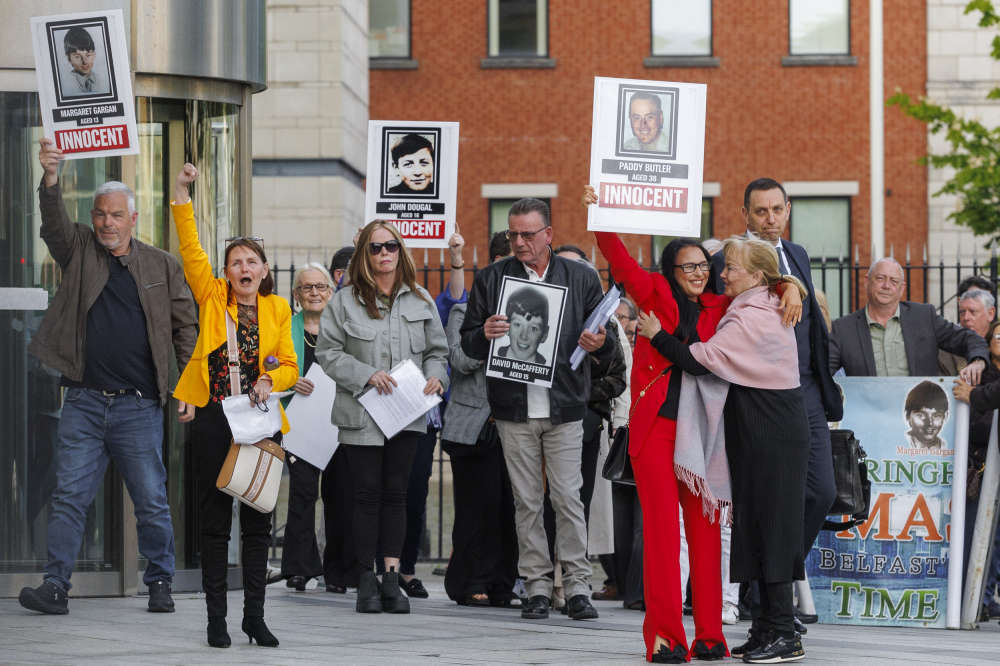
Natasha Butler with relatives of those killed during the Springhill Westrock killings outside Belfast Coroner's Court, where the inquest into the 1972 west Belfast shooting found that soldiers did not use reasonable force in shooting dead three teenagers, a father-of-six and a Catholic priest in the Springhill and Westrock areas of Belfast (Liam McBurney/PA Wire)
 Children in long-term workless households highest for more than a decade
 Northern Ireland Secretary to return to Hillsborough for Drumcree talks
 Tulip Festival Returns to Glenarm Castle with Northern Ireland’s First-Ever Squishmallows Experience
 Business Beats Cancer Belfast Raises an Incredible £50,000 for Cancer Research UK
 NI CHILDREN’S BOOKS SERIES THE WEATHERBIES LAUNCH ALL-IRELAND SCHOOLS COMPETITION
Comments
Add a comment