

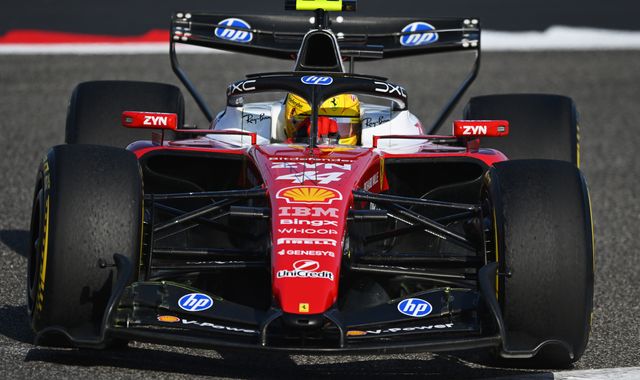
What's different about the new cars in 2026?
Lots of things are different about the new cars, after the biggest regulation overhaul we've ever had in F1.
Normally we have regulation overhauls where a bit of aerodynamics change, or a bit of the engine change, but now pretty much everything is new.
- When to watch the Australian GP live on Sky Sports
- F1 2026: Calendar, line-ups, new regulations, how to watch on Sky Sports
- Not got Sky? Get Sky Sports or stream with no contract on NOW?
In terms of the chassis, the cars are smaller and lighter. The minimum weight they can be is lower, while they're smaller in both length and width.
As well as that, the tyres are smaller. But as part of that, there are new tyres. So, we've effectively got new compounds from Pirelli. And because they're smaller, they will react differently as well.
And what about the aerodynamics?
We previously had the ground-effect era, where the floor was producing a lot of downforce and the cars were being run really close to the ground.
Now we've got an aerodynamic platform that more closely matches what we had before the last regulation change in 2022. And that means that we're beginning to see cars with more rake, which refers to when the rear ride height is noticeably higher than the front ride height, so the car looks a bit nose down.
We've also got the addition of what's been widely described as active aero. The rear wing moves in much the same way as it did with DRS, where it will change in order to reduce drag on the straight with the aim of increasing straight line speed.
But as well as that, the front wing moves at the same time, so it's two methods of reducing drag on the straight in order to get more speed. And that is going to happen every lap in what we're going to call straight mode.
So there'll be certain straights around the tracks, where all cars, regardless of the situation, will change their wings in order to have less drag.
What's different about the engines?
The other big change that's been talked about a lot is with the power units. We talk about the power unit being the engine and the battery, a combined system. The big change in that is where previously we had the engine producing the majority of the power, now we've got more of a 50-50 split between the engine and the battery.
These cars have had batteries in them producing power since 2014, so for a long time we've had batteries in there. But the batteries now produce more of that power, and that means that engine manufacturers have had to adjust how they supply power to the wheels.
Previously, the cars could gain energy - much like a road car does - under braking. That's one method of charging the battery that still exists, but it also used to take heat from the engine itself and use that to generate power, and now that's forbidden.
So that's one of the reasons that the batteries have had to get bigger. And hopefully it's a simpler overall engine, and quite road relevant in terms of what it does. But it means that teams have had to come up with a compromise of how they operate the engine and run it.
How will the changes impact racing?
I think there's a few quite big differences on how the cars are driven and how it will affect racing. The idea of making the car smaller is to make it more agile and hopefully improve overtaking. I think that's a step in the right direction because F1 cars in recent years have been getting bigger and bigger. Some of that has been down to safety regulations, but now we're keeping those safety advances but making the cars smaller.
Because we're going away from ground-effect, the cars will produce less downforce. That means that it's going to feel slippier for a driver, so it will be more in the drivers' hands to control the car and get the most out of it.
As for the engine changes, where previously cars used DRS when they were within one second of the car ahead, now the replacement system, straight mode, is going to be available for use on every straight, regardless of how close you are to the car in front.
In terms of a specific overtaking aid for when a car gets within a second of the car ahead, DRS is being replaced by an overtake button. That button gives the driver the ability to use more of the energy that's in the battery in order to close the gap or complete an overtake.
It's very similar to DRS in terms of how it will look off board, giving a driver an opportunity to close the gap or make a move.
As well as that, and this is actually very similar to what's always happened, the drivers have the ability to use some more of their battery at certain points with what will be known as 'boost' mode. That's, to a lesser degree, always been a function of the battery in the engine.
There's going to be more management of the energy within the lap, but that's something that's been happening in the background in F1 for a long time.
Having seen the cars on track in Bahrain, going around the lap, they look fairly similar. So we don't know as yet how much the racing on track will change.
Are the starts going to be different?
At starts, because the cars have lost that facility to harvest energy from the heat, they've had to put in nominally bigger turbos. When the car is starting off the grid, same rule as always, they can't use the battery power until they hit 50 kph.
That's to prevent things like launch control, traction control, to try to create variability across the drivers. Some teams have a smaller turbo in the engine that is easier to get up to speed quickly. Some teams have a bigger turbo, which is maybe better when you're running in a race, but harder to get off the line, which is why we're seeing such variability in the starts.
What will happen is teams will find methods around it, and we're seeing lots of them holding revs on the grid to get the turbo going. But I think there's going to be way more variability in the starts than what we've seen previously, and that's quite exciting.
How will racing vary at different circuits?
Although it's not always been obvious to the viewer, there have always been circuits, even with the old battery, where teams haven't been able to deploy fully on every straight, and they've had to decide which straight they're going to limit their deployment a little bit earlier, which straight they're going to push harder. Teams have always had that compromise.
Qualifying's easy because you just do what's optimum around the lap for the best time, but the race is more variable because maybe you take some energy out of a short straight where you know you can't be overtaken and put it on a long straight where you're trying to defend.
But again, that has always existed. It's just been a bit blind to us.
You will get circuits where it's easier to overtake, easier to manage the energy, circuits where it's difficult to manage the energy.
Bahrain, which hosted both official pre-season tests, was a circuit where actually the speed trace of the cars was very similar to what we'd seen last year. And then you will get circuits where it's very different, where it's really effective to take a bit of energy from one part of the circuit and put it into another.
So, we will see variability, and every time we go to a new circuit, I think when we get there, we'll see teams taking very different approaches to what their energy management looks like in first practice, and then maybe they all converge as we get towards qualifying. But I think we will see quite different approaches.
What will look different for fans?
In terms of watching the cars go round corners, watching the cars on track, the wings are going to be a bit different in terms of straight mode happening every lap.
I think the one thing that you're going to see more of is variability in driving, we're actually pushing more emphasis on the driver doing a good job. He's going to have less grip, so maybe lock-ups become harder, old tyres become harder, all of these things.
And they're going to have to be more on top of what their battery's doing, how much energy they have, not wasting it in certain places. So that's going to change a little bit.
Watching from home on TV, we're going to have different graphics in terms of what the battery's doing or how much energy they have left. But I see that as additional information over what we had before.
I don't expect the racing to be dramatically different. You're still going to have to use your tyres early in the stint to overtake. You still may well require a tyre delta if you want to overtake. You're going to use your battery to try and help with that in the way you would have done with DRS before.
Do the drivers need new skills for these cars?
I think there will be a few things that will challenge them. One is understanding these new engines. Some drivers have said they are having to totally rewire their brains on how the car works.
They'll need to understand when to harvest energy, be that going into a corner, or braking a little bit earlier in the straight. They'll probably need more overall awareness of how safe they are from the car behind, if they can harvest a bit more, or how at risk they are at certain positions. That'll need more management in terms of the electronics.
They will have less grip. It will be a bit like the adjustment the drivers have to make every year in Mexico, where the very high altitude and therefore low downforce makes it slippy and cause initial struggles.
Whereas last year's car had so much downforce that you were probably power-limited a lot of the time, in this year's cars you'll be grip-limited a lot of the time, so it's quite a big difference in how you drive the car.
There'll also be a host of new procedures, such as the start, pit stops they do pit stops.
Will these differences suit some drivers more than others?
I think some drivers and teams will come out on top. The best way of describing it is: since we've gone to the Pirelli tyres, they've needed a degree of management through stints, and some drivers have really benefited from that - Checo Perez, for example, is really good at managing his tyres. He's maybe struggled a bit in qualifying when the management of the tyres isn't as important.
And it will be the same with the power units, the energy, the grip levels. For example, the different methods with which different drivers approach corners, for example the way they manage their braking and steering settings, could make a big difference.
There's so many fundamental differences in the way these guys drive these cars, that I think it will suit people. Lewis Hamilton is the example that's been talked about the most, but there will be others that will come out on top, I think.
Sky Sports F1's Australian GP schedule
Thursday March 5
3am: Drivers' Press Conference
6am: Paddock Uncut
9.45pm: F3 Practice
10.55pm: F2 Practice
Friday March 6
1am: Australian GP Practice One (session starts at 1.30am)*
2.55am: F3 Qualifying*
3.30am: Team Bosses Press Conference
3.50am: F2 Qualifying*
4.35am: Australian GP Practice Two (session starts at 5am)*
6.15am: The F1 Show*
Saturday March 7
0.10am: F3 Sprint*
1.10am: Australian GP Practice Three (session starts at 1.30am)*
3.05am: F2 Sprint*
4.10am: Australian GP Qualifying build-up*
5am: AUSTRALIAN GRAND PRIX QUALIFYING*
7am: Ted's Qualifying Notebook*
9.45pm: F3 Feature Race*
Sunday March 8
12.20am: F2 Feature Race*
2.30am: Australian GP build-up: Grand Prix Sunday*
4am: THE AUSTRALIAN GRAND PRIX*
6am: Australian GP reaction: Chequered Flag*
7am: Ted's Notebook*
7.55am: Australian GP race replay*
10am: Australian GP highlights (also on Sky One)*
*Also on Sky Sports Main Event
Watch every race of the 2026 Formula 1 season live on Sky Sports, starting with the Australian Grand Prix from March 6-8. Stream Sky Sports with NOW - no contract, cancel anytime
(c) Sky Sports 2026: F1 2026 rules: Explaining new cars, engines, modes and racing ahead of Australian GP first race with Bernie Collins
 Aston Villa's Ollie Watkins and Newcastle's Nick Pope suffering poor form but James Garner stars for Everton
 Liverpool have transformed their set-piece record by copying key trend sweeping the Premier League
 Important goals and big saves: Jordan Pickford, Hugo Ekitike and Bruno Fernandes among those to deliver key Premier League moments
 T20 World Cup: England captain Harry Brook on India semi-final, Jos Buttler, Will Jacks and calmness under pressure