
By Michael McHugh, Press Association
Northern Ireland's Appeal Court has said abortion reform should be left to Stormont's Assembly.
It said the complex moral and religious questions behind the issue should be determined by a legislature rather than a court.
The three judges allowed an appeal against a lower court's ruling that abortion legislation was incompatible with the UK's Human Rights Act obligations.
Sarah Ewart who made headlines after travelling to England to have a termination because her baby had foetal abnormalities spoke outside Belfast Appeal court along with Amnesty's Grainne Teggart:
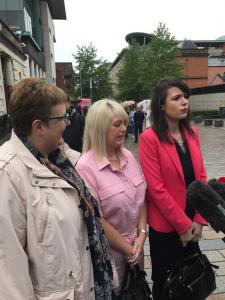
Grainne Teggart (right) of Amnesty International and Sarah Ewart (centre)
Unlike other parts of the UK, the 1967 Abortion Act does not extend to Northern Ireland, where abortions are illegal except where the life or mental health of the mother is in danger.
Anyone who performs an illegal termination could be jailed for life.
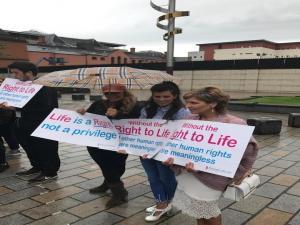
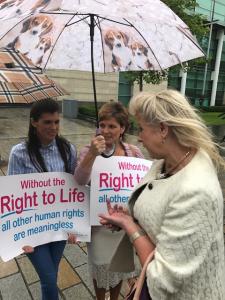
Bernie Smyth of Precious Life spoke to journalists outside the Appeal Court:
Lord Justice Gillen said: "Abortion is a classic instance of the type of highly controversial issue touching on social, moral and religious policies on which there is no consensus either in Europe or, for that matter, in this jurisdiction.
"Such an issue requires Parliament to be allowed a wide margin of judgment."
Northern Ireland's senior judge, Lord Justice Declan Morgan, invited legal submissions on sending the case to the Supreme Court.
Outside the Royal Courts of Justice Les Allamby from the Human Right's Commission spoke to reporters:
 Jury told to consider ‘different strands’ of evidence in Natalie McNally murder case
 Civil case taken by IRA victims ‘verged on show trial’, Gerry Adams says
 High Court told Gerry Adams ‘major, major player in war!'
 Natalie McNally murder accused ‘lied and lied again’
 Woman dies in two-vehicle collision in Enniskillen