

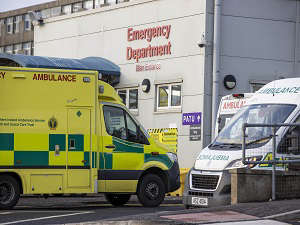
By Rebecca Black (Press Association)
Stormont has been urged to address the “catastrophe” unfolding in Northern Ireland’s hospital emergency departments (EDs).
A report by the Royal College of Emergency Medicine (RCEM) stated that, in 2025, some 1,032 excess deaths were associated with waits of 12 or more hours in EDs while awaiting admission.
The body’s State of Emergency Medicine in Northern Ireland report found that, while the overall death figure for 2025 is slightly lower than in 2024 (1,122) and 2023 (1,063), the estimated mortality figure has more than doubled over five years.
In 2020, the estimated mortality figure was less than half of what it was in 2025 – at 461. A decade ago, in 2016, there were 60 excess deaths attributed to long waits.
The report also contends that overcrowding and long waits in EDs are not the result of an increase in demand, and that the numbers attending departments has “barely changed”, while the number of long waits, and deaths, have “skyrocketed”.
It found that in 2025, one in 12 (8.3%) patients waited 24 hours or longer, while a RCEM survey conducted in December 2025 found that one ED recorded a wait time of over 124 hours – more than three days.
The report makes a number of recommendations for the Northern Ireland Executive.
These include ending corridor care and mortality associated with long waits in ED by the end of the decade, adopting a “whole-system approach to ending ED overcrowding”, with responsibility for performance spread across the entire patient pathway.
The recommendations also include ensuring accountability for ending overcrowding and to implement measures to make excess deaths associated with long waits in ED to be treated with the same seriousness as deaths in other medical specialties.
Dr Michael Perry, Northern Ireland vice president for the Royal College of Emergency Medicine, urged that the situation is treated like the “catastrophe in need of redress that it is”.
“Behind these numbers are stories of families ripped apart by avoidable deaths which have happened because successive governments have failed to grab the ED crisis by the horns,” he said.
“We must not let the slight reduction on the previous year give us false assurance that the problem is being fixed. Such a glacial pace of progress is not good enough.
“Our health service has the highest rates of long waits in EDs, and deaths per capita resulting from them, of any UK nation. That statement should shock our policymakers to the core.
“Politicians and system leaders need to treat this like the catastrophe in need of redress that it is.”
Dr Perry said it is a “fixable problem”.
“While, sadly, we cannot help the loved ones who have already experienced a bereavement at the hands of a broken system, we know what measures can prevent future heartbreak,” he said.
“Our report contains the answers. Accountability, a whole-system approach to patient flow and targets to ending corridor care and deaths associated with long waits will make the difference.
“We look forward to hearing from policymakers eager to put these measures in place.”
A Department of Health spokesperson said: “The minister and department acknowledge the continued pressures on our emergency departments.
“This is a complex problem with no quick fix but the only medium to long term solution is to reduce demand and manage demand differently.
“That means reducing the number of people coming through ED doors, as well as getting people out of hospital as soon as they are fit for discharge to free up beds.
“Our reset plan is attempting, over the next three years, to refocus our work towards earlier support and intervention, prevention, providing neighbourhood-based care and encouraging people to take more responsibility for their own health on a routine basis.
“We are also looking at how we can care for our frail elderly patients better by providing more care closer to home and preventing avoidable admissions to hospital.
“However, we recognise that this will take time to have an impact and it is not helped by the very challenging financial position.
“In the interim, we will continue to manage the quality of care we are able to provide to the best effect ensuring the needs of our patients and staff remain our priority.
“The minister has discussed patient flow and hospital discharge issues with HSC chief executives, and all agreed the need to increase community capacity was the most important single change that is required.
“This is consistent with the reset plan towards a neighbourhood model of delivery.”
 Man injured after house and three vehicles set alight in Co Antrim
 IT system for Northern Ireland schools ‘largely restored’ following cyber attack
 £100 home heating oil grant to be paid out by ‘summer at earliest’
 Arrest made after hot water thrown over man at Co Tyrone court
 Judgment reserved after trial of three men accused of murdering Lyra McKee